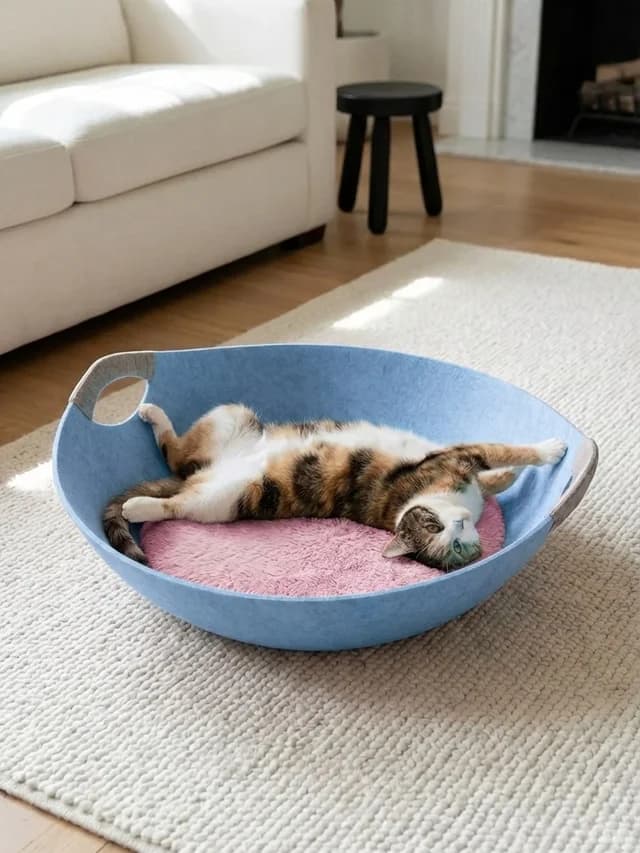
Why Your Cat Sleeps on Your Clothes Instead of Their Bed (And How to Fix It)
That pile of laundry your cat keeps claiming? It smells like you, it's warm, and it's soft. Your cat bed has none of those things — but it can.

You spent $40 on a cat bed. Your cat sleeps on your dirty laundry. You try moving the bed closer to where she usually naps. She moves to the other pile of laundry. You put the bed on top of your clothes. She pulls your clothes out from under the bed and sleeps on those instead.
Sound familiar? This is one of the most common frustrations cat owners face — and one of the most misunderstood. Your cat isn't being ungrateful or difficult. She's telling you something important about how cats experience the world.
Cats live in a scent-dominated world
To understand why your cat prefers your worn t-shirt to a brand-new bed, you need to understand something fundamental about feline perception: cats rely on scent far more than vision to assess their environment.
The AAFP 2013 guidelines highlight this in Pillar 5: "Respect the importance of the cat's sense of smell." Cats have roughly 200 million olfactory receptors compared to our 5 million. Their vomeronasal organ (Jacobson's organ) processes chemical signals that humans can't even detect. For a cat, the scent profile of an object is at least as important as how it looks or feels.
Your worn clothes are saturated with your scent. Not the perfume or deodorant layer — the baseline body scent that identifies you uniquely as their person. For a bonded cat, this scent is the strongest comfort signal available. It says: "My human was here. This place is safe."
Why a new bed smells "wrong"
A bed fresh from the packaging smells like factory, warehouse, shipping materials, and possibly a dozen strangers' hands. To a human, it smells like "new product." To a cat, it smells like "unknown territory."
Cats are neophobic by nature — they're cautious about new things in their environment. This is a survival instinct. In the wild, a new object in a familiar territory could signal a predator or a territorial intruder. Most domestic cats aren't afraid of new beds exactly, but they don't feel drawn to them either. Given the choice between an unfamiliar object and a pile of laundry that smells exactly like their favorite person, the laundry wins every time.
It's also about warmth and shape
Scent is the main reason, but it's not the only one. Your clothes offer two other things cats love:
- Residual body heat.Clothes you recently wore still carry some warmth. Cats have a thermoneutral zone of about 86–97°F (30–36°C), which is higher than most room temperatures. They're perpetually seeking warmth, and your recently-worn clothes are a mild heat source. Our article on why cats seek warm spots goes deeper on the science here.
- A crumpled, enclosed feeling.A pile of laundry isn't flat — it's a soft, irregular mound with folds and drapes that a cat can nestle into. This mimics the enclosed, den-like feeling that cats naturally seek when resting. A flat bed sitting in the open offers none of this cozy cave effect.
How to get your cat to use their actual bed
The fix isn't complicated once you understand the underlying logic. You need to make the bed smell like "safe" and feel like "cozy."
1. Transfer your scent to the bed
This is the single most effective thing you can do. Take the bed liner or a small blanket and sleep with it for a night — tuck it next to your pillow or under your sheets. One night is usually enough to deposit a meaningful amount of your scent. Then place it in the cat bed.
Alternatively, rub a soft cloth on your cheeks and neck (where you have natural oils), then rub that cloth on the inside of the bed. It's less effective than sleeping with it, but it's quicker.
2. Place the bed where your scent already is
Next to your side of the bed. On the couch where you usually sit. Near your desk chair. Cats want to be near your scent trail, and a bed placed in a scent-rich location will be adopted faster than one placed in a clean, neutral corner.
3. Don't wash the bed too often
This is counterintuitive for humans but essential for cats. Once your cat has started using a bed, they deposit their own scent through facial rubbing, paw kneading, and just lying in it. Every wash resets this scent profile to zero, and the cat has to start the adoption process over again.
Spot-clean when needed, but avoid full washes unless there's a hygiene issue. Felt and wool are naturally antimicrobial and odor-resistant, which makes them ideal materials for cat beds that don't need frequent washing.
4. Introduce the bed gradually
Don't remove your cat's current favorite sleeping spot (yes, even if it's your laundry pile) and replace it with a new bed. That creates a negative association. Instead, place the new bed near the existing spot and let the cat discover it on their own timeline. Most cats transition within 7–10 days if the bed smells right and is in a good location. For a step-by-step approach, check out our gradual introduction guide.
5. Choose beds made from scent-retaining materials
Not all materials hold scent equally. Synthetic polyester and nylon tend to shed scent quickly and require more frequent re-scenting. Natural fibers — especially wool and felt — have a more complex surface structure that traps and holds scent molecules longer.
This is one of the practical advantages of felt cat beds that rarely gets mentioned in marketing. Our Bowl Cat Bed and Pink Felt Bowl Bed are both made from thick wool felt that naturally retains scent for weeks after initial use. Once your cat's scent is embedded in the felt, the bed becomes "theirs" in a way that synthetic materials struggle to replicate.
What NOT to do
- Don't force the cat into the bed.Placing your cat in a bed they haven't chosen creates a negative association, not a positive one.
- Don't spray the bed with artificial scents. Essential oils, air fresheners, and perfumes can overwhelm a cat's sensitive nose and actively repel them. Some essential oils are also toxic to cats.
- Don't give up after three days.Cats are slow adopters of new objects. If the bed has your scent, is in a good location, and isn't washed constantly, most cats will use it within two weeks.
The bottom line
Your cat sleeps on your clothes because your clothes smell like you, and your scent is the strongest safety signal in their world. It's a compliment, honestly — your cat is telling you they feel safe with your presence.
The fix is to bring that same scent into the bed. Sleep with the liner, place the bed in a scent-rich location, and resist the urge to wash it too often. Choose a felt bed that holds scent naturally. Give it a week or two. Your cat will figure it out — and you'll get your laundry back.
Sources & Further Reading
- Ellis, S.L.H., Rodan, I., Carney, H.C., et al. (2013). AAFP and ISFM Feline Environmental Needs Guidelines. Journal of Feline Medicine and Surgery, 15(3), 219–230.
- Vitale Shreve, K.R., & Udell, M.A.R. (2015). What's inside your cat's head? A review of cat (Felis silvestris catus) cognition research past, present and future. Animal Cognition, 18(6), 1195–1206.
- Bradshaw, J.W.S. (2013). Cat Sense: The Feline Enigma Revealed. Allen Lane / Penguin Books.
Products Mentioned
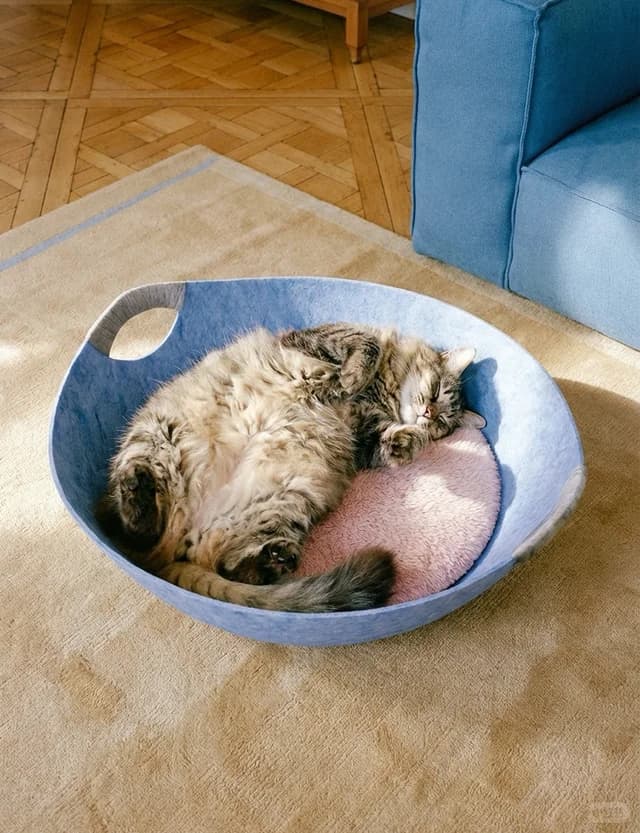 Best SellerOnly 0 left
Bowl Cat Bed
Premium woven felt bowl bed — your cat's favorite nap spot
Low stock: 0 left
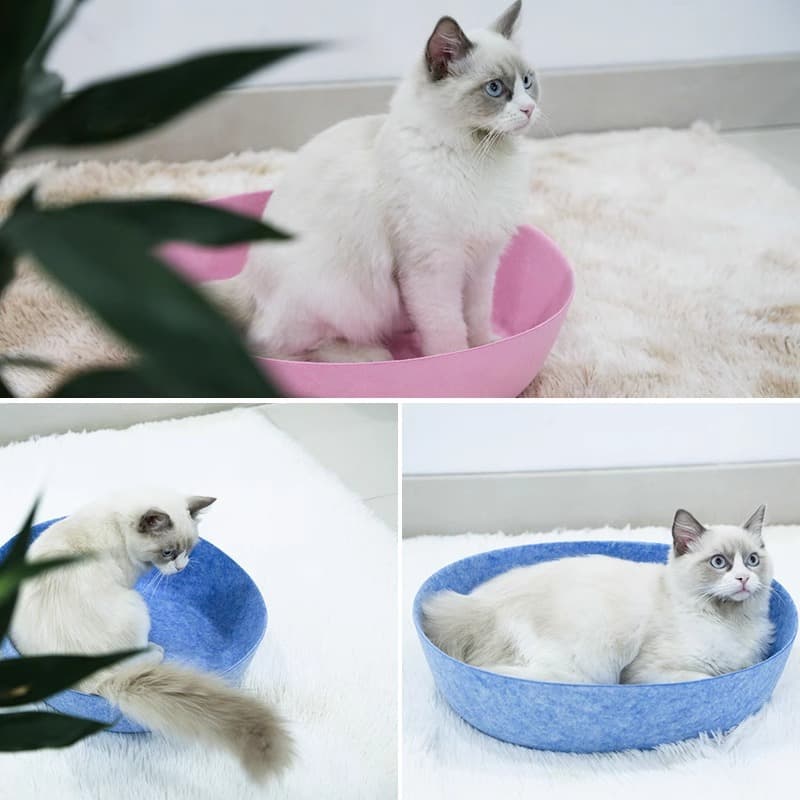 Spring EditionOnly 0 left
Pink Felt Bowl Bed
Spring edition blush pink bowl bed in premium felt
Low stock: 0 left
 Only 0 left
Hexagon Cat Nest
Geometric hexagonal bed with built-in scratch surfaces
Low stock: 0 left