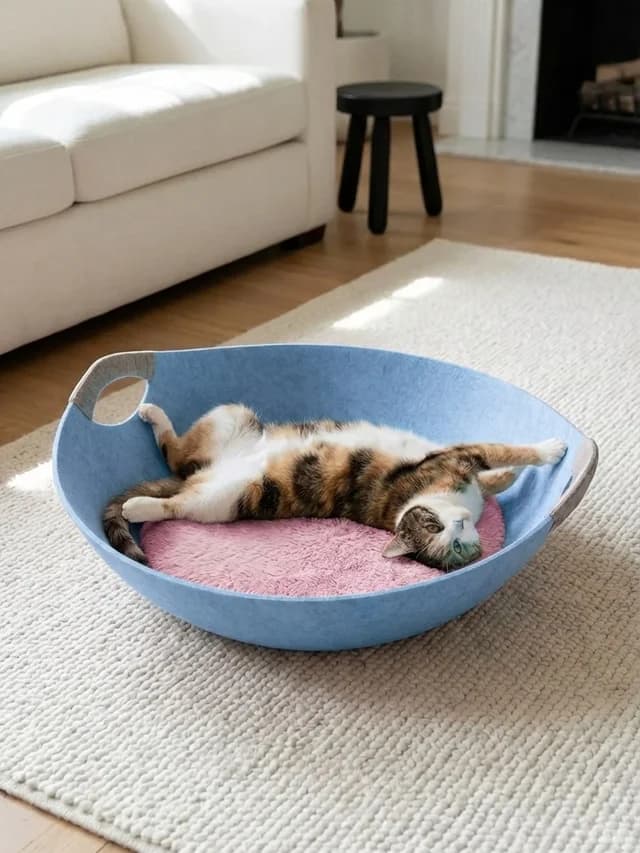
How to Get Your Cat to Actually Use a New Bed (A Behavioral Approach)
Cats are neophobic — new things take time. Rushing a bed introduction is the single most common reason cats reject perfectly good beds.

You finally bought a beautiful new cat bed. Your cat took one look, walked away, and went to sleep on your unwashed laundry. Welcome to one of the most universally frustrating experiences of cat ownership.
The good news: this almost never means you bought the wrong bed. It usually means you introduced it wrong. Cats are neophobic — a well-documented trait meaning aversion to new things. Rushing a bed introduction is the single most common reason cats reject perfectly good beds.
What neophobia actually is
Neophobia is the natural fear of novel stimuli. In cats it's been studied extensively, particularly in research on feral cat management and shelter intake, where new objects and environments are the default (Ryan-Schofield 2024, Wildlife Society Bulletin). The core finding: cats are cautious about new objects, and acceptance takes longer than researchers initially expected.
In practical terms, your cat's reaction to a new bed is almost never about the bed itself. It's about the novelty. That means the fix is almost never to return the bed — it's to slow down and let your cat approach it on their own terms.
The 7-day gradual introduction method
This protocol is based on how feline behaviorists introduce new objects and is the same method we recommend to customers whose cats are slow to adopt a new bed.
Day 1–2: Place, don't push
Put the new bed in a neutral part of the room your cat already uses. Don't put it in the exact spot where their old bed was, and don't try to make them go into it. Just let it exist in their environment. Cats evaluate new things from a distance.
Day 3: Scent transfer
Take a small cloth and gently rub it on your cat's cheeks (where their facial scent glands are). Place the cloth inside the new bed. This transfers the cat's own scent marker onto the bed, which makes it feel familiar. You can also add a blanket that already smells like your cat — something from their old bed, for example.
Day 4: Add an attractant
A small pinch of catnip, silver vine, or (if your cat isn't into catnip) a favorite treat placed at the edge of the bed encourages investigation. Silver vine is often more effective than catnip — research shows silver vine affects around 80% of cats, versus about 50–70% for catnip.
Day 5–6: Reward any interaction
If your cat sniffs the bed, steps on it, or lies down on it, drop a small treat next to them or speak in a soft praise voice. Don't pick them up and put them in. Don't force anything. Cats learn by association, and you're building the connection "new bed = good things happen here."
Day 7+: Move to the preferred spot
Once your cat has started using the bed voluntarily, you can gradually move it to your preferred location (near the window, in the bedroom, next to the sofa). Move it 12–18 inches per day over several days rather than relocating it all at once — this avoids resetting the novelty response.
Common mistakes that reset the process
- Picking your cat up and placing them in the bed. This is the most common mistake. It makes the bed feel like a trap and creates a negative association. Cats decide where they sleep. Period.
- Moving it too many times in the first week.Each move resets the cat's evaluation. Pick a spot and leave it.
- Washing the bed immediately after the cat uses it. You just removed the scent marker the cat spent days depositing. Wait at least 2–3 weeks before the first wash, and afterward, spot-clean whenever possible.
- Scolding for using the old bed in the meantime. You want positive associations only. Let them use whatever they've been using while the new bed earns its place.
- Giving up after day 3.A lot of cats take a full 1–2 weeks. One study on neophobia specifically noted that acceptance takes "longer than researchers thought." Give it time.
Bed design matters, too
If you've done all of the above and your cat still won't use it, the bed might genuinely be the wrong design. Cats strongly prefer:
- Enclosed, walled shapes over flat pads (see our article on why cats love boxes)
- Natural fibers like wool felt over synthetic plush
- Warmth and insulation (see our article on the feline thermoneutral zone)
- Quiet, low-traffic locations
Our Bowl Cat Bed and Hexagon Cat Nest were both designed with these preferences in mind — so if you're starting from scratch, those are good defaults.
The short version
Your cat's refusal to use a new bed is almost never about the bed. It's about novelty. Slow down. Rub some of their scent onto it. Add a little catnip. Let them decide. By day 7–10 most cats have adopted a well-designed bed that was introduced correctly.
Sources & Further Reading
Products Mentioned
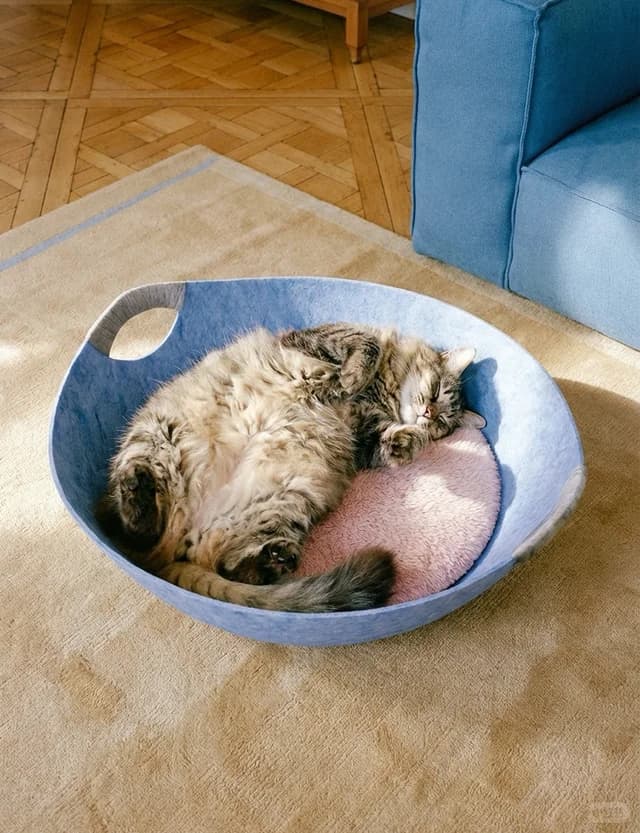 Best SellerOnly 0 left
Bowl Cat Bed
Premium woven felt bowl bed — your cat's favorite nap spot
Low stock: 0 left
 Only 0 left
Hexagon Cat Nest
Geometric hexagonal bed with built-in scratch surfaces
Low stock: 0 left
 Spring EditionOnly 0 left
Pink Felt Bowl Bed
Spring edition blush pink bowl bed in premium felt
Low stock: 0 left