Why Your Cat Is Always Cold (And What to Do About It)
When your cat hogs the sunbeam or buries themselves under a blanket, they're not being cute. They're actually cold by their body's standards.
Your cat is not wrong to steal the sunbeam. They are genuinely, biologically colder than you are, at the same room temperature. It turns out feline thermal comfort is one of the more interesting quirks of cat physiology, and it has real implications for where they choose to sleep.
The feline thermoneutral zone
The thermoneutral zone(TNZ) is the ambient temperature range in which an animal doesn't have to burn extra calories to stay warm or cool. For humans, the TNZ is around 68–77°F (20–25°C). That's why you feel comfortable in a normal air-conditioned room.
For domestic cats, the TNZ is much higher — somewhere around 86 to 100°F (30–38°C), according to multiple veterinary and feline welfare sources including the American Veterinary Society of Animal Behavior (AVSAB). In other words, when you are comfortable at 72°F, your cat is actively expending energy to stay warm.
This isn't a defect. Cats evolved from Felis lybica, the African wildcat, which lived in North African and Middle Eastern deserts where daytime temperatures regularly hit 90°F+. Their physiology is still tuned to warmer environments than most human homes provide.
Why it affects your cat's behavior all day
Because your cat is always slightly "under" their TNZ in a typical home, their sleeping and resting choices are disproportionately driven by heat. Watch a cat for a full day and you'll see:
- They follow sunbeams across the floor hour by hour as the sun moves through windows.
- They curl into tight balls during rest — this minimizes body surface area exposed to air, reducing conductive heat loss.
- They seek elevated spots near vents, radiators, warm appliances, or on top of electronics that emit heat.
- They press against other cats or humans during sleep to share body warmth.
- They burrow under blankets, into closets, and against walls — all strategies to trap their own body heat.
None of this is "being cute." It's active thermoregulation.
Which cats feel the cold most
Every cat benefits from a warm bed, but some are significantly more cold-sensitive:
- Senior cats (10+). Older cats have reduced muscle mass and slower metabolism, making it harder to generate body heat. Arthritic senior cats are also more vulnerable to cold-induced joint stiffness.
- Short-haired and hairless breeds. Siamese, Devon Rex, Sphynx, and similar breeds have dramatically less insulation than Maine Coons or Norwegian Forest Cats.
- Thin or small cats. Less body mass means less thermal reserve.
- Kittens under 4 months.They can't fully regulate their own body temperature yet and rely heavily on external warmth.
- Cats recovering from illness or surgery. The body diverts energy to healing, leaving less for thermoregulation.
How to give your cat warmth without cranking the thermostat
You don't need to heat your home to 86°F to make your cat happy. Cats create local warm microclimates wherever you help them. Practical options:
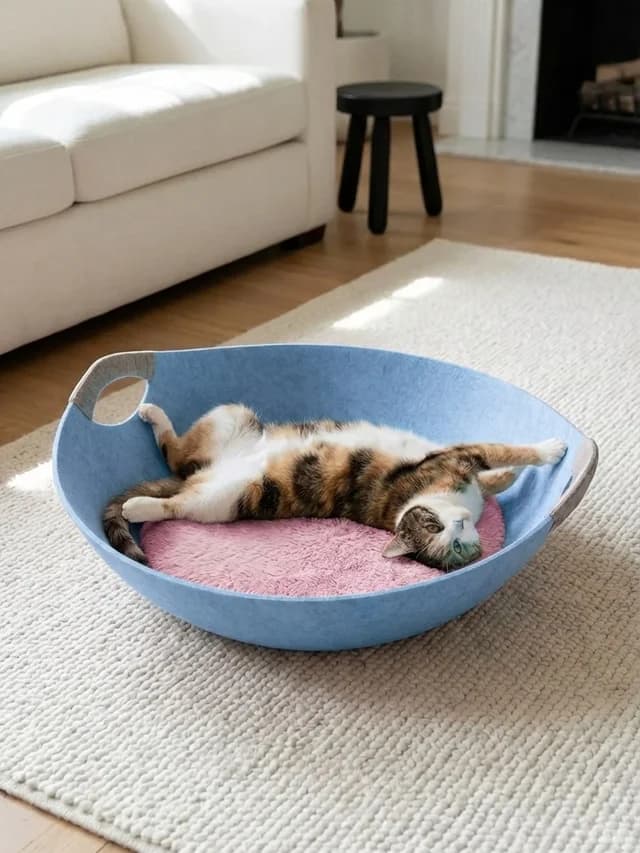
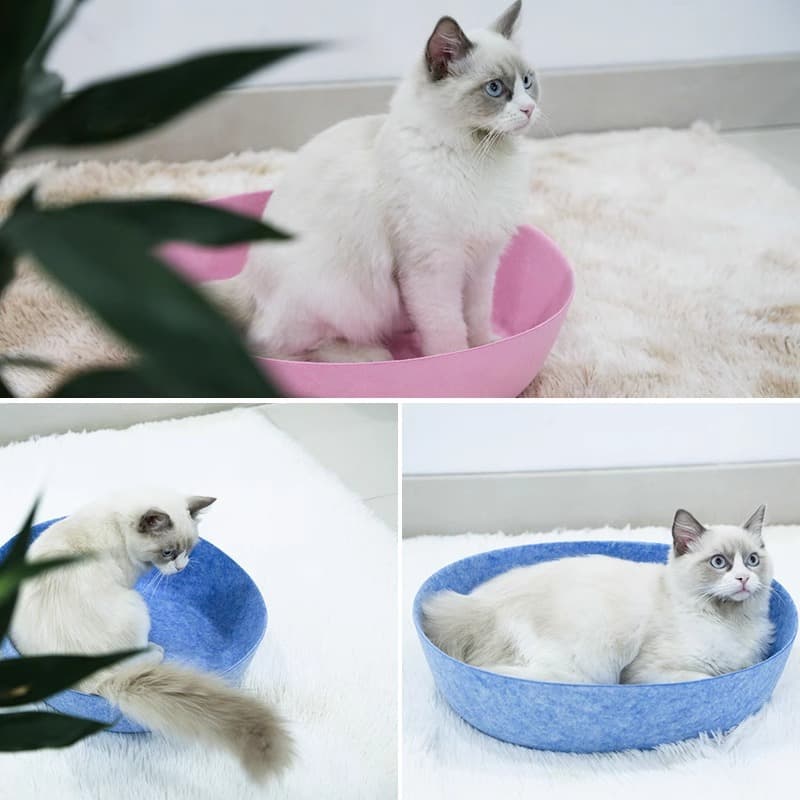
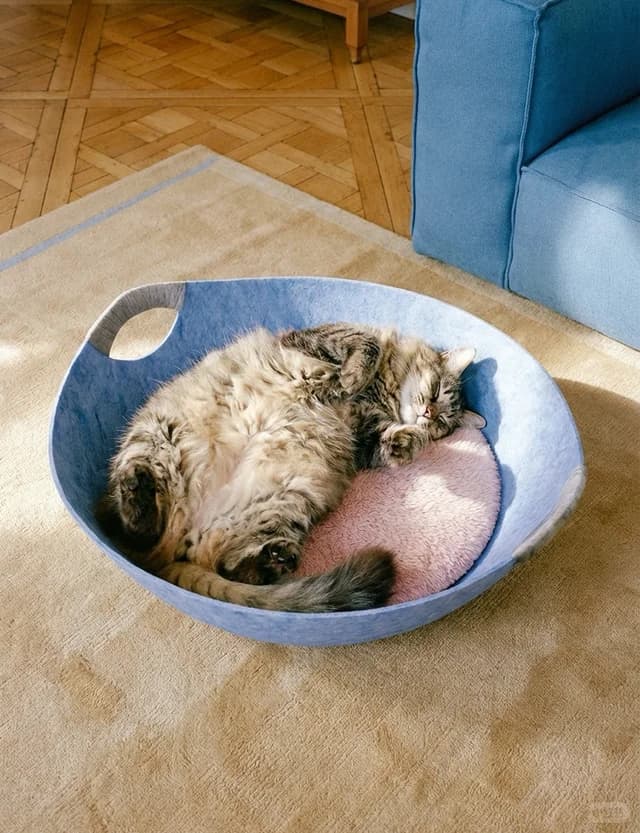
- An insulating bed. Wool felt is one of the best natural insulators for cat beds. It traps body heat in and keeps ambient cold out. Our Bowl Cat Bed is made from thick premium wool felt precisely for this reason.
- Enclosed shapes.A deep bowl or hexagon bed traps the cat's own radiant heat far better than a flat cushion. You're not adding heat, you're preventing loss. The Hexagon Cat Nest works on this same principle.
- Bed placement near sun. Put at least one bed where afternoon sun hits. A bed in a sunbeam can be 10–15°F warmer than the rest of the room.
- Away from drafts. Cold drafts under doors and near windows can make a bed useless no matter how insulated it is. Avoid placing beds in hallways or near exterior doors.
- Soft warming pads for seniors. For arthritic older cats, a vet-approved low-temperature heating pad placed under their main bed can substantially improve comfort and mobility.
The warning signs your cat is actually cold
Most of the time, a cold cat is just seeking warmth. But if you see any of the following, it's worth intervening more actively:
- Shivering or trembling
- Cold ears or paw pads
- Hunched posture with tucked paws for long periods
- Reluctance to leave a warm spot even for food
- Constant burrowing under blankets
If you see these, consider adding a warmer bed, placing existing beds in warmer spots, or (for seniors) consulting your vet about heated beds.
The simple rule
When you're comfortable in a sweater, your cat is probably cold in theirs. Choose a bed that insulates, put it somewhere warm, and let them do what cats have been doing for ten thousand years: finding the warmest spot in the house and owning it.
Sources & Further Reading
Products Mentioned
 Best SellerOnly 0 left
Bowl Cat Bed
Premium woven felt bowl bed — your cat's favorite nap spot
Low stock: 0 left
Spring EditionOnly 0 leftPink Felt Bowl Bed
Spring edition blush pink bowl bed in premium felt
Low stock: 0 left
 Only 0 left
Hexagon Cat Nest
Geometric hexagonal bed with built-in scratch surfaces
Low stock: 0 left