Best Enclosed Cat Beds for Anxious Cats That Hide (Vet-Backed Guide)
Hiding is a healthy stress response for cats — but if your cat hides for hours daily, they need a dedicated enclosed space that's theirs alone. The right bed changes everything.
A behavioral veterinarian told me something that reframed how I think about cat anxiety: "When a cat hides, that's not a problem behavior — that's a coping strategy. The problem is when they don't have a safe place to hide, so they end up stuck in an open room with no exit option."
If your cat disappears under the bed every time a guest arrives, hides during thunderstorms, or spends hours in small enclosed spaces after any disruption — they're not antisocial. They're anxious and coping the only way they know how. The research is clear that giving anxious cats a permanent, designated hiding space — one they control and can retreat to predictably — significantly reduces chronic stress. The right enclosed cat bed is that space.
Why Anxious Cats Need Enclosures, Not Just Comfort
A 2014 study by Vinke et al. in Applied Animal Behaviour Science tracked shelter cats provided with hiding boxes vs. control cats without them. Cats with hiding boxes had significantly lower cortisol levels within the first two weeks and recovered from the stress of the shelter environment faster. This wasn't a subtle effect — the hiding box group showed measurably different stress markers.
The behavioral mechanism is called "perceived safety." An enclosed space gives a cat the ability to monitor their environment from a position where nothing can approach from behind or above. This is why your cat chooses the space under the bed (walls on three sides, ceiling above, limited entry points) over an open plush mat in the middle of the room — even if the mat is infinitely softer.
What Makes a Good Enclosed Bed for an Anxious Cat
- Single, small entry point — One opening, sized just wide enough for your cat to enter, means only one direction to watch. Multi-opening designs defeat the purpose for a genuinely anxious cat.
- High, opaque walls — The cat should be able to curl inside without any part of their body visible from the outside. Clear or mesh walls provide no security benefit.
- Stable, non-tipping structure— Anxiety spikes when a hiding spot shifts or moves. A bed that rocks when your cat enters at speed will be abandoned quickly. Heavy wool felt construction provides rigidity that lighter materials don't.
- Positioned with the opening facing the room, back against a wall — Your cat needs to see the room from their hiding spot. Place the bed in a corner or against a wall so the back is protected.
- Familiar scent before introduction— An anxious cat will reject a new bed if it smells unfamiliar. Before introducing any new bed, rub it with a cloth that carries your cat's scent from their current sleeping spot.
Our Recommended Options
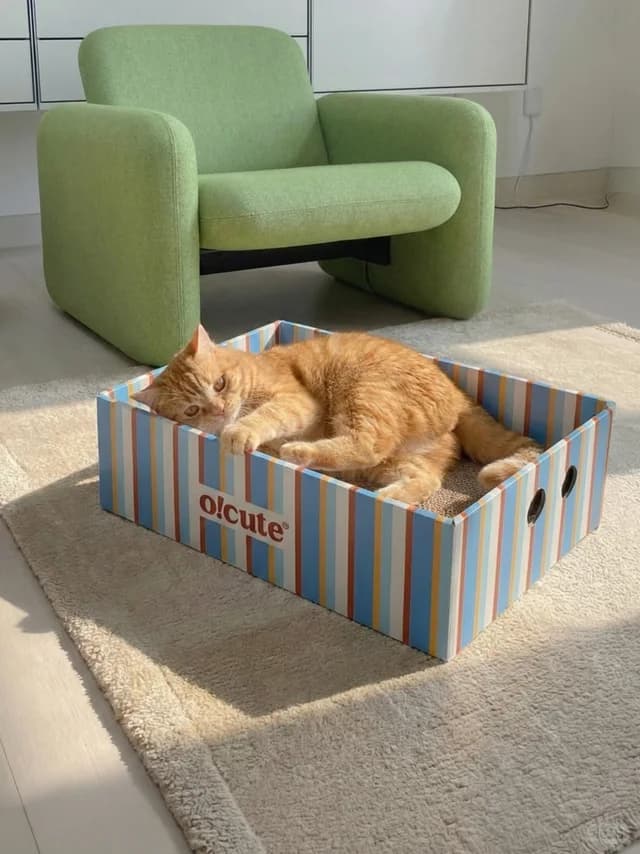
The Hexagon Cat Nestis specifically designed for cats that need enclosed security. The hexagonal structure creates a deep interior with a single front opening, opaque felt walls that block outside visual stimuli, and a base weight that prevents tipping. The felt material also absorbs scent over time, making the bed "smell like home" faster than synthetic fabrics.
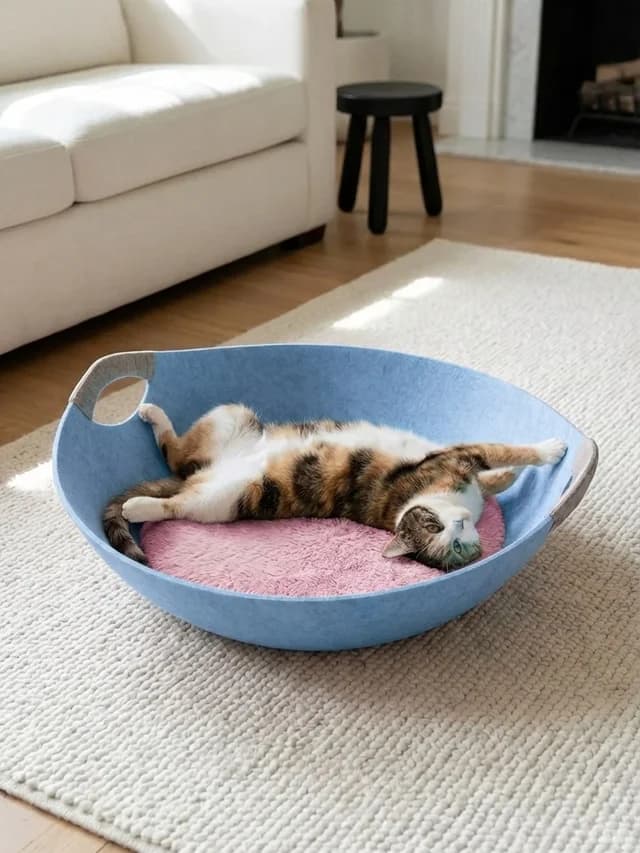
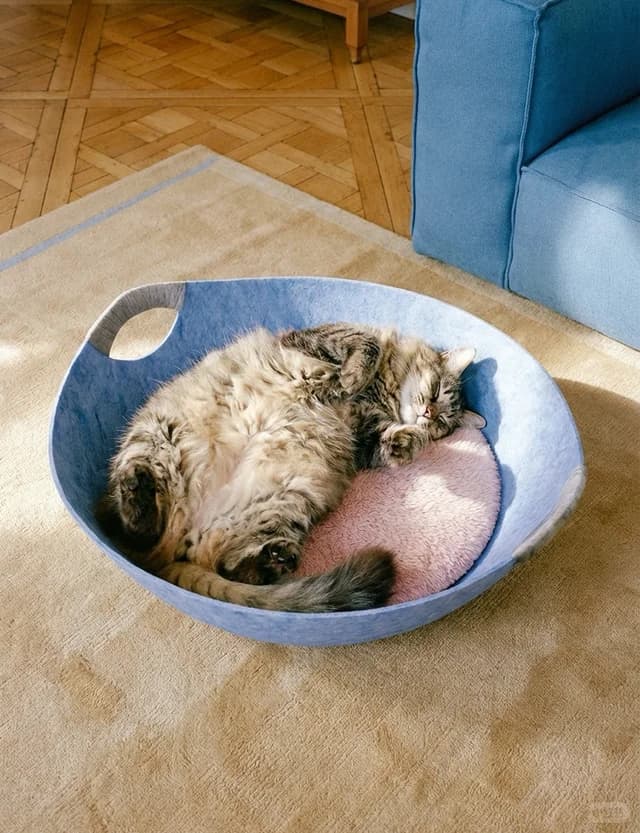
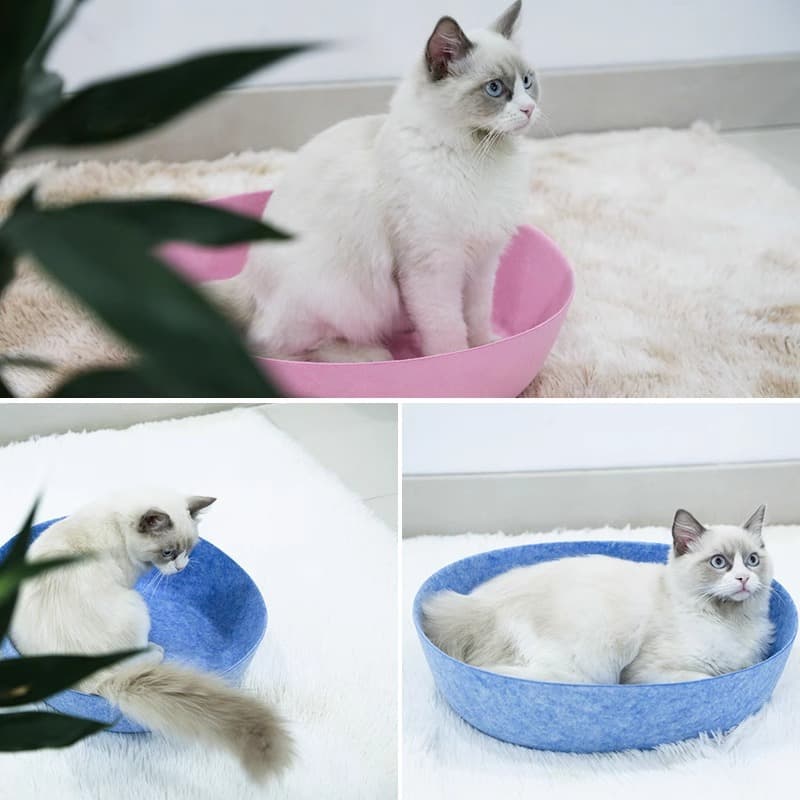
For cats who prefer something closer to ground level — many anxious cats distrust elevated positions — our Bowl Cat Bedhas high surrounding walls that create a partially enclosed microenvironment while remaining low to the floor. It's a good middle ground for cats who are anxious but not fully hiding-oriented.
Where to Place an Anxious Cat's Bed
Placement matters as much as the bed itself. Research on cat spatial preferences identifies several key factors:
- Elevated positions (12–36 inches) — Slightly elevated gives a visual advantage without the vulnerability of a high perch. On a low shelf or beside a sofa is ideal.
- Adjacent to primary social areas — Counter-intuitively, anxious cats do better when their safe space is near where people gather, not hidden in a back bedroom. Being able to observe safely is reassuring; being isolated amplifies anxiety.
- Away from noisy appliances — Washing machines, dishwashers, and refrigerators emit intermittent noise that spikes cortisol in anxious cats. Avoid placing beds in laundry rooms or kitchens.
- Multiple locations — For a highly anxious cat, provide two enclosed resting spots in different rooms. This gives the cat options and prevents them from being cornered if something startles them near their only retreat.
Common Mistakes
- Disturbing the cat while they're hiding. Let them come out on their own terms. Reaching into an enclosed bed to pet a hiding cat breaks the security of the space and makes them less likely to use it.
- Using the bed as a carrier substitute. If you ever use the enclosed bed to transport your cat to the vet, they will associate it with veterinary stress and stop using it voluntarily. Keep the safe bed separate from the carrier.
- Washing the bed too frequently at first. Familiar scent is a major source of security. In the first month, spot-clean only. Full washing removes the scent markers that make the bed feel safe.
- Buying an open, flat bed for a hiding-oriented cat. No amount of soft material compensates for the lack of visual protection. If your cat hides, they need walls.
Sources & Further Reading
- Vinke, C.M., Godijn, L.M., & van der Leij, W.J.R. (2014). Will a hiding box provide stress reduction for shelter cats? Applied Animal Behaviour Science, 160, 86–93.
- Ellis, S.L.H., et al. (2013). AAFP and ISFM Feline Environmental Needs Guidelines. Journal of Feline Medicine and Surgery, 15(3), 219–230.
- Herron, M.E. & Buffington, C.A.T. (2010). Environmental enrichment for indoor cats. Compendium, 32(12), E4.
Products Mentioned
 Only 0 left
Hexagon Cat Nest
Geometric hexagonal bed with built-in scratch surfaces
Low stock: 0 left
 Best SellerOnly 0 left
Bowl Cat Bed
Premium woven felt bowl bed — your cat's favorite nap spot
Low stock: 0 left
 Spring EditionOnly 0 left
Pink Felt Bowl Bed
Spring edition blush pink bowl bed in premium felt
Low stock: 0 left