How to Choose the Perfect Cat Scratcher for Kittens: First-Time Owner's Guide
The scratcher you buy for your kitten now will define their scratching habits for life. Here's what to look for — and what most first-time owners get wrong.
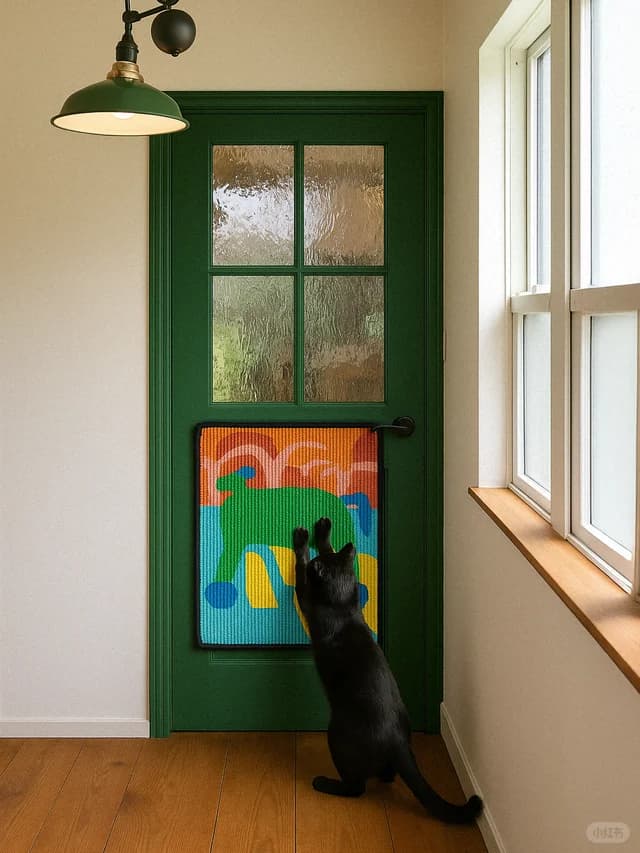
Bringing home a kitten is one of the most exciting — and chaotic — experiences a cat owner can have. Between the tiny zoomies, the ankle attacks, and the relentless exploration of every corner of your home, there's one behavior that starts almost immediately and never stops: scratching. The good news is that if you set up the right scratching environment from day one, you'll save your furniture and give your kitten exactly what it needs to develop into a well-adjusted adult cat.
When do kittens start scratching?
Kittens begin scratching as early as 2 to 4 weeks old, right around the time they start weaning. At this age, the behavior is instinctual — they're not trying to destroy anything. They're learning to extend and retract their claws, stretch their developing muscles, and mark territory with the scent glands in their paw pads. A study by Cisneros et al. (2022) found that cats between 4 and 12 months of age have the highest scratching rates of any age group. This is the window where habits form — and where your choices as an owner matter most.
The scratching patterns your kitten develops during this critical period tend to persist into adulthood. A kitten that learns to use a cardboard scratcher at 3 months old will naturally gravitate toward scratchers as an adult. Conversely, a kitten that learns to scratch the sofa because no alternative was provided will keep doing exactly that for years.
What materials do kittens actually prefer?
Not all scratching surfaces are created equal. Zhang & McGlone (2020) tested cat preferences across different scratching substrates and found that rope (sisal) and corrugated cardboard were significantly preferred over carpet and fabric. This matters because many mass-market scratching posts are covered in carpet — which cats tend to ignore in favor of your actual carpet or upholstered furniture.
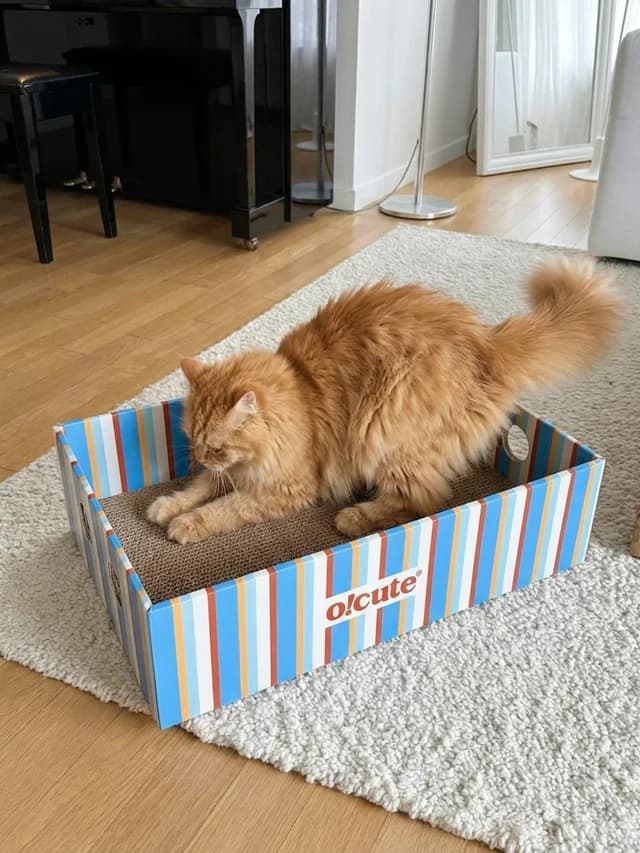
For kittens specifically, corrugated cardboard is an ideal starting material. It's soft enough for tiny claws, provides satisfying shredding feedback, and is inexpensive enough that you won't mind replacing it every few weeks. A Striped Scratch Box is a great first scratcher — it sits flat on the floor, which suits kittens who haven't yet developed the confidence to stretch vertically, and the corrugated cardboard hits the preferred-material sweet spot.
Start small, then graduate
A common mistake is buying a full-size cat tree for a 10-week-old kitten. Those tall structures can actually be intimidating — and if the kitten can't comfortably reach the scratching surfaces, it simply won't use them. Instead, start with floor-level scratchers and work your way up as your kitten grows.
- 8-16 weeks: Flat cardboard scratchers placed near sleeping areas and play zones. The Striped Scratch Box or 3-in-1 Scratch Box work perfectly at this stage.
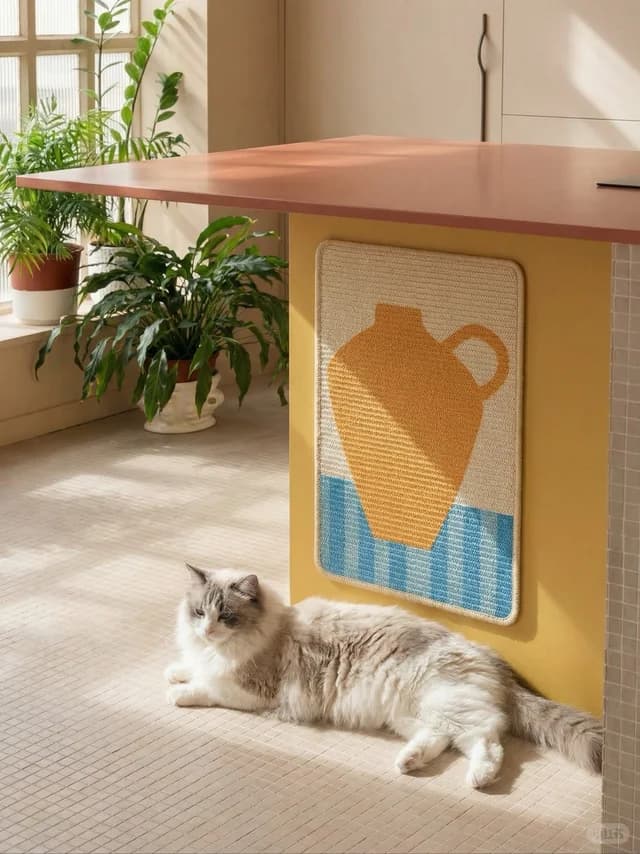
- 4-8 months: Introduce angled and vertical scratchers. Your kitten is now bigger, more confident, and craving a full-body stretch. This is the right time to add a Sisal Wall Mat mounted low on the wall.
- 8+ months:Your cat is approaching adult size. Wall-mounted scratchers can be moved to standard height, and you can add taller vertical options. The habits are mostly set by now — you're reinforcing, not establishing.
Placement matters more than you think
Cats scratch when they wake up, when they're excited, and when they want to mark important territory. That means scratchers belong in high-traffic, socially significant areas — not tucked away in a spare bedroom. Place at least one scratcher near your kitten's favorite sleeping spot (they almost always scratch right after waking), and another in the main living area where the family spends time.
If your kitten starts scratching a specific piece of furniture, put a scratcher directly next to it. You're not fighting the behavior — you're redirecting the location. For more on strategic placement, see our guide on how to stop cats from scratching furniture.
Encouragement techniques that actually work
The ASPCA is clear on this point: never force a kitten onto a scratching surface by holding its paws and making a scratching motion. This creates a negative association and can make the kitten actively avoid the scratcher. Instead, use positive reinforcement:
- Catnip: Sprinkle dried catnip on the scratcher. About 50-70% of cats respond to catnip, though kittens under 3 months may not react at all — the sensitivity develops with age.
- Silver vine:If catnip doesn't work, try silver vine (Actinidia polygama). Research shows it triggers a response in roughly 80% of cats, including many who are catnip-indifferent.
- Play association: Drag a feather toy across the scratcher surface. The kitten will dig in its claws during play and accidentally discover that scratching this surface feels great.
- Treats and praise: Every time your kitten scratches the right thing, reward immediately. Cats learn through immediate consequences, not delayed rewards.
The science of preference formation
Understanding the science behind scratching preferences helps explain why early intervention is so powerful. Cats are creatures of habit — once they've established a scratching routine in a particular location with a particular substrate, that pattern becomes deeply ingrained. The neural pathways that form during kittenhood are essentially the default operating system for adulthood.
This is why it's much easier to establish good scratching habits with a kitten than to retrain an adult cat. You're not overwriting existing preferences — you're writing the original ones.
What to avoid
- Punishment.Squirting water, yelling, or swatting your kitten for scratching the wrong thing teaches it to scratch when you're not watching, not to stop scratching entirely.
- Declawing.This is an amputation of the last bone of each toe. It's banned in many countries and increasingly discouraged by veterinary organizations worldwide. It causes chronic pain and behavioral problems.
- Too few scratchers.One scratcher for the whole house isn't enough. Aim for at least 2-3, in different locations and orientations (horizontal and vertical).
Building a kitten scratching setup on a budget
You don't need to spend a fortune. A solid starter kit might look like this: one flat cardboard scratcher like the Striped Scratch Box for everyday use, and one 3-in-1 Scratch Box that offers multiple angles as your kitten grows. When your cat reaches 5-6 months and starts stretching taller, add a Sisal Wall Mat for vertical scratching. Total investment: well under $100, and you've set up habits that will last a lifetime.
The best time to start is the day your kitten comes home. The second best time is today.
Sources & Further Reading
- Cisneros, A.V., et al. (2022). Providing an outdoor-like environment and scratching substrate can reduce owner-reported problematic scratching in cats. Frontiers in Veterinary Science, 9, 900652.
- Zhang, L. & McGlone, J.J. (2020). Scratcher preferences of indoor domestic cats and their impact on furniture scratching. Applied Animal Behaviour Science, 227, 105010.
- ASPCA. Destructive Scratching — Common Cat Behavior Issues.
Products Mentioned
PopularOnly 0 leftStriped Scratch Box
Colorful striped box with corrugated scratch pad inside
Low stock: 0 left
 Only 0 left
3-in-1 Scratch Box
Scratcher + bed + play box in one colorful package
Low stock: 0 left
 Only 0 left
Sisal Wall Mat
Designer striped wall-mounted sisal scratching mat
Low stock: 0 left