Calming Cat Beds for Anxious Cats: What Works and What Doesn't
Marketing claims aside, the research on what calms a stressed cat is clear — and it's not about magic fabrics. It's about shape, placement, and scent.
Search for "calming cat bed" online and you'll find hundreds of products with names like "anti-anxiety donut bed" and "stress-relief plush lounger." The marketing is compelling. But how much of it is backed by actual evidence — and how much is just fluffy copywriting?
The answer, as with most things in animal behavior, is nuanced. Certain bed features genuinely help anxious cats. Others are pure marketing. This guide separates the two based on published research and veterinary guidelines.
What cat anxiety actually looks like
Before we talk about solutions, it's worth recognizing what feline anxiety looks like — because it's often subtler than people expect. Cats don't pace and whine like anxious dogs. Instead, they get quieter. Common signs include:
- Overgrooming — Licking or chewing fur to the point of creating bald patches, especially on the belly or inner thighs.
- Hiding more than usual — A cat that used to sit in the living room but now spends most of the day under the bed or in a closet.
- Appetite changes — Either eating significantly less or stress-eating (yes, cats do this too).
- Litter box issues — Urinating or defecating outside the box, particularly in new locations, can be a stress response.
- Aggression or irritability— Swatting, hissing, or biting when they normally wouldn't.
If your cat shows multiple signs from this list, a bed alone won't fix the problem. Talk to your veterinarian. But the right environment — including the right resting spaces — is a real part of the solution.
The science: enclosed spaces reduce stress
The single most relevant study here is by Vinke et al. (2014), who studied newly arrived shelter cats and found that cats given a hiding box adjusted significantly faster and showed lower stress scores (measured by the Cat-Stress-Score, or CSS) than cats without a hiding option. The difference was measurable within just a few days.
This makes intuitive sense if you understand cat behavior. In the wild, cats are both predators and prey. When stressed, their instinct is to find a small, enclosed space where threats can only approach from one direction. It's why your cat squeezes into cardboard boxes that seem too small — and why she might prefer your laundry basket over a wide-open bed. For more on this, read our deep dive into why cats love boxes.
The AAFP and ISFM Feline Environmental Needs Guidelines (2013) formalize this as Pillar 1 of their five-pillar framework: every cat needs a "safe place." The guidelines define this as a private, enclosed area where the cat can retreat and feel secure — ideally elevated, or at least partially enclosed on multiple sides. Our AAFP Five Pillars guide covers all five pillars in detail.
What actually calms an anxious cat
Based on the research and veterinary guidelines, here's what genuinely helps:
1. Enclosed or semi-enclosed shape
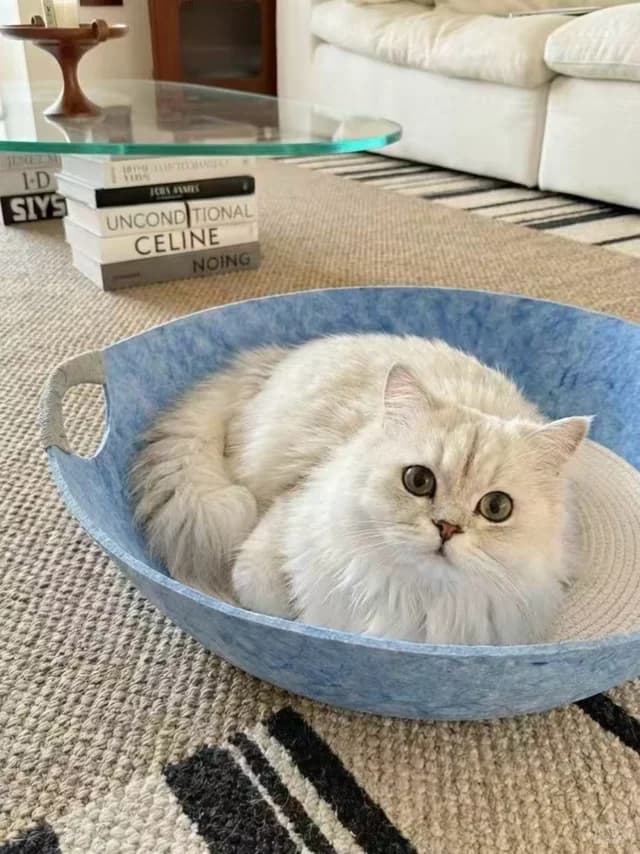
This is the single most important feature. A bed with high walls, a hood, a cave shape, or a deep bowl gives the cat a sense of being sheltered. They can curl up inside and monitor just one opening instead of feeling exposed from every angle. The Vinke study showed that even a simple cardboard box is enough — shape matters far more than material.
2. Familiar scent
Cats identify safe spaces partly through scent. A bed that smells like the cat (or like you, their trusted human) registers as "safe" far faster than a brand-new product fresh out of packaging. The best approach: unpack a new bed and leave it near where your cat already sleeps for a few days before moving it. Rub a soft cloth on your cat's cheeks and then rub it on the inside of the bed to transfer facial pheromones.
3. Quiet, low-traffic location
Placement matters as much as the bed itself. A "calming bed" placed next to the front door, the washing machine, or the kids' playroom isn't calming at all. Put it in a quiet corner, ideally slightly elevated (on a shelf or side table), where the cat can see the room but isn't in the path of foot traffic.
4. Routine and predictability
Anxious cats benefit from predictability. Don't keep moving the bed around the house. Once your cat has adopted a spot, leave it there. A consistent environment is inherently less stressful than one that keeps changing.
What doesn't work (despite the marketing)
Let's address the elephant in the room: "anti-anxiety fabric."
Many calming beds are marketed with claims that their faux-fur or plush material has inherent anti-anxiety properties. The idea is that the soft, fluffy texture mimics a mother cat's fur and triggers a soothing response. It's a nice story. There's just no published evidence supporting it.
Some cats do prefer softer textures, just as some prefer smoother ones. But the calming effect comes from the shape, location, and scent familiarity of the bed — not from the specific fabric. A wool felt cave bed works just as well (and often better, since it retains scent and warmth more effectively than synthetic plush).
Similarly, "self-warming" is often listed as a calming feature. Warmth is nice and can help cats relax, but it's not specific to anxiety. Any insulating material provides this benefit.
Our recommendations for anxious cats
The Hexagon Cat Nest is a strong pick for anxious cats. Its semi-enclosed hexagonal shape gives cats a defined, sheltered space while still allowing them to peek out. The corrugated walls also double as a scratching surface — and scratching is itself a stress-relief behavior for cats, so having it built into their safe space is a genuine bonus.
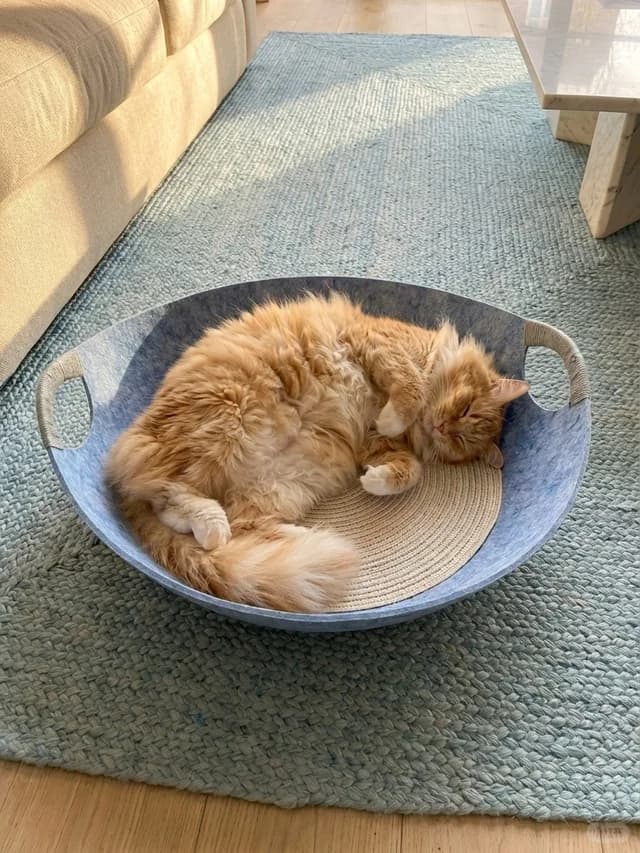
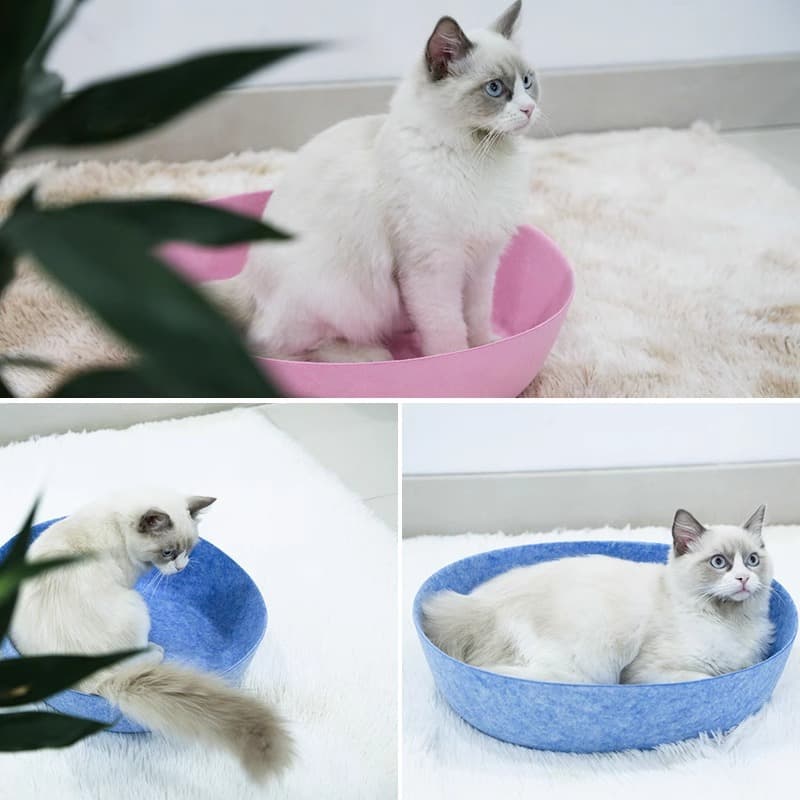
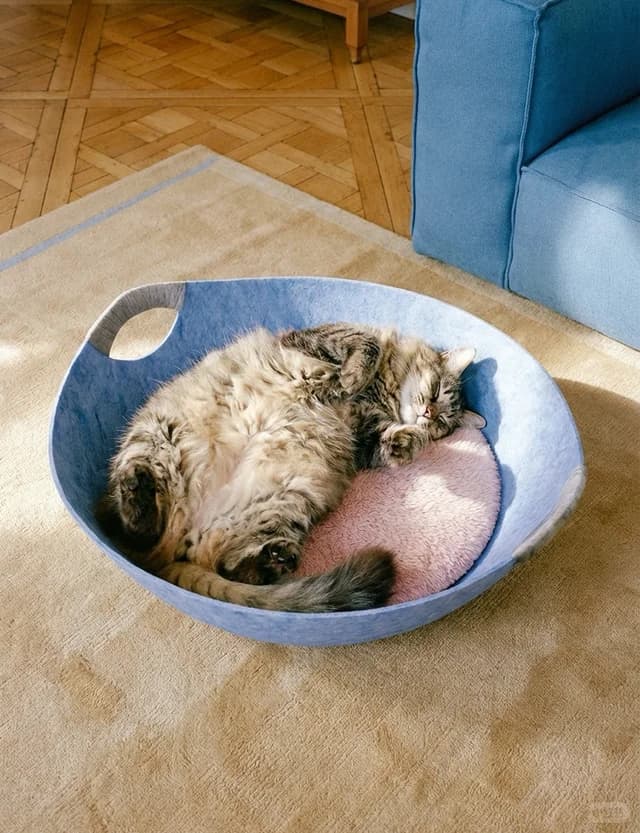
The Bowl Cat Bedis another good option, especially for cats who prefer a semi-enclosed rather than fully enclosed space. The deep bowl shape wraps around the cat's body, and the thick felt walls provide both warmth and a visual barrier that makes the cat feel less exposed. It won't eliminate anxiety on its own, but combined with good placement and scent management, it creates the kind of predictable, sheltered rest space that the research says makes a real difference.
When a bed isn't enough
A bed is one piece of the puzzle. If your cat's anxiety is severe — if they're not eating, they're hiding all day, or they're showing aggression — please consult a veterinarian or a certified animal behaviorist. Environmental modifications like better bedding are recommended alongside, not instead of, proper veterinary care. Feliway diffusers, dietary changes, and in some cases medication may be needed.
But for mild to moderate stress — a new home, a new pet in the household, a schedule change — the right bed in the right spot, with familiar scent and a predictable routine, does genuinely help. Just don't pay extra for marketing buzzwords.
Sources & Further Reading
- Vinke, C.M., Godijn, L.M., & van der Leij, W.J.R. (2014). Will a hiding box provide stress reduction for shelter cats? Applied Animal Behaviour Science, 160, 86–93.
- Ellis, S.L.H., Rodan, I., Carney, H.C., et al. (2013). AAFP and ISFM Feline Environmental Needs Guidelines. Journal of Feline Medicine and Surgery, 15(3), 219–230.
- Kessler, M.R., & Turner, D.C. (1997). Stress and adaptation of cats (Felis silvestris catus) housed singly, in pairs and in groups in boarding catteries. Animal Welfare, 6(3), 243–254.
Products Mentioned
 Best SellerOnly 0 left
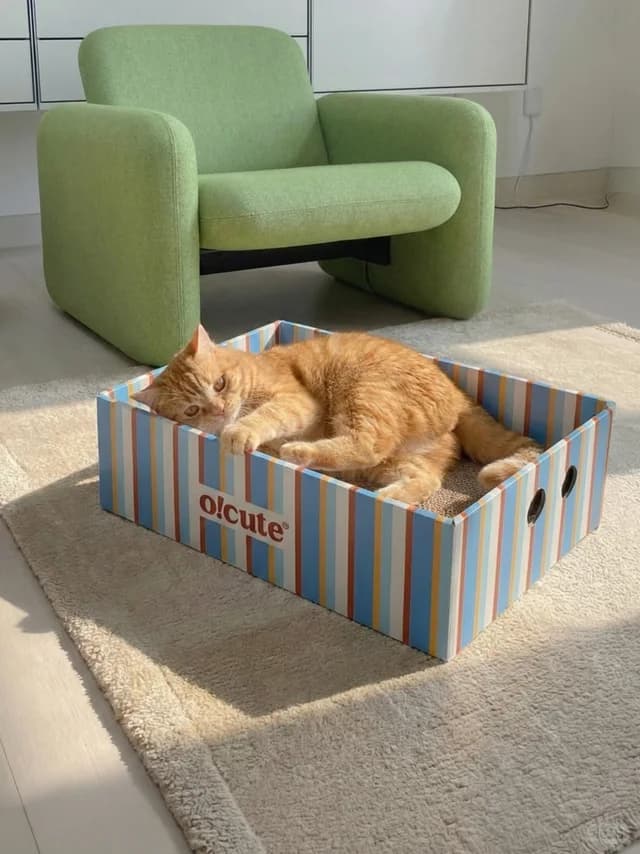
Bowl Cat Bed
Premium woven felt bowl bed — your cat's favorite nap spot
Low stock: 0 left
 Only 0 left
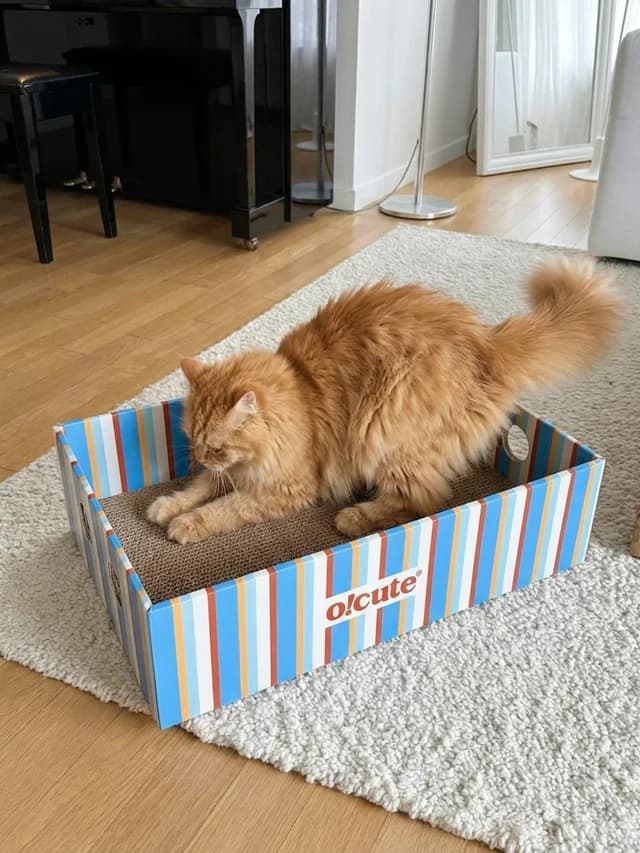
Hexagon Cat Nest
Geometric hexagonal bed with built-in scratch surfaces
Low stock: 0 left
 Only 0 left
3-in-1 Scratch Box
Scratcher + bed + play box in one colorful package
Low stock: 0 left