Cat Wall Shelves: How to Build a Vertical Cat Highway Your Cat Will Use
Every square foot of floor space is valuable in a small home. Cat wall shelves reclaim unused vertical space — and cats are evolutionarily wired to prefer high territory anyway.

Every square foot of floor space in a small home has to justify its existence. Cat wall shelves solve the vertical territory problem without claiming floor real estate — and cats, who spend their entire evolutionary history navigating trees and rocky terrain, are instinctively drawn to height in a way they're not drawn to floor-level beds.
Why vertical territory matters for indoor cats
In multi-cat households, vertical space directly reduces conflict. Cats establish social hierarchies partly through height — the highest position is the highest status. When all resources (beds, food, rest spots) are at floor level, conflict between cats competing for position is almost inevitable. Wall shelves at multiple heights allow each cat to find an appropriate position without confrontation.
In single-cat households, vertical territory reduces stress by increasing the cat's perceived control of their environment. A cat that can observe the whole room from a high shelf has a fundamentally different psychological experience than one limited to ground-level sightlines. The AAFP/ISFM guidelines identify perching opportunities as a core environmental need.
Planning a cat wall shelf system
The most effective systems work as a “cat highway” — a connected series of shelves at varying heights that a cat can traverse continuously rather than a single isolated shelf with no path up or down.
Height placement: Start at jumping height (20–30 inches off the floor) and work up. The top shelf should be accessible from a lower shelf or a piece of furniture, not require a single leap of more than 24 inches. Senior cats or those with joint issues need closer shelf spacing (12–16 inches between shelves).
Shelf width: 12 inches minimum for a sitting cat. 16+ inches for a lying cat. Cats hanging their legs off edges is fine — they prefer this — but the core of the shelf should support lying flat.
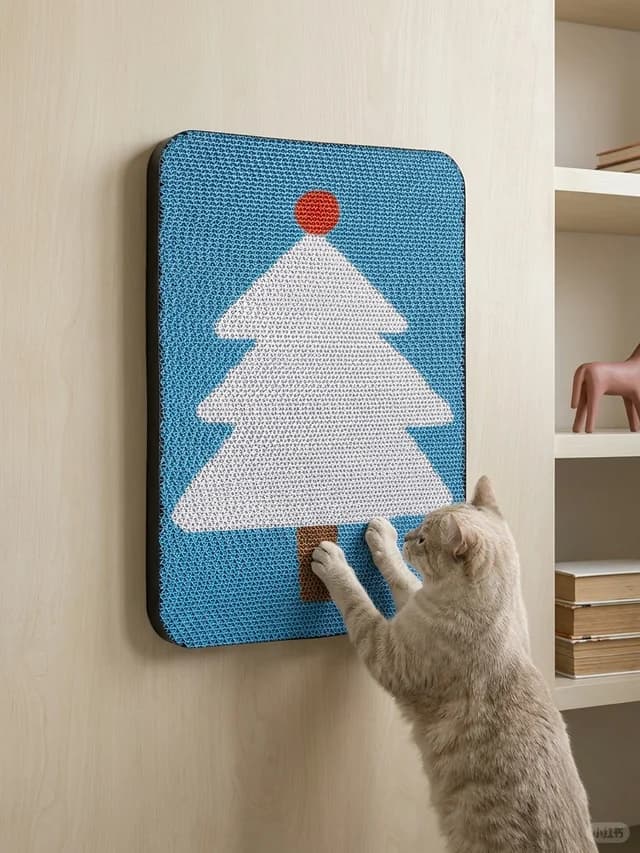
Surface texture: Smooth wood or MDF is too slippery for confident jumping and landing. Carpet, sisal, or textured rubber pads are dramatically preferred. Our wall scratcher provides sisal texture for both scratching and confident footing.
Load capacity: A 15 lb cat landing with full impact force generates significantly more load than its static weight. Any shelf and mounting hardware should be rated for at least 30–40 lbs.
Common layout patterns
Staircase: Shelves ascending in a diagonal line, each offset 8–12 inches higher than the last. Easy for cats to navigate, easy for owners to install. Works well in corners.
Perimeter highway: Shelves running along three walls of a room at consistent height, creating a continuous circuit. Best for multi-cat households with conflict issues.
Feature wall: Multiple shelves at varied heights, depths, and angles on a single wall, creating a visual display as well as cat territory. Often combined with aesthetic elements like plant brackets or picture frames at lower heights.
Installation notes
Every shelf must be anchored to wall studs, not just drywall. A cat landing on a drywall-anchor-only shelf at speed will bring it down, potentially injuring the cat. Use a stud finder, anchor into studs, and use hardware rated for the expected dynamic load. Most DIY cat wall shelf installations that fail do so because of inadequate anchoring, not shelf design.